
Google Eliminates Use of Third-Party Cookies in an Attempt to Protect Users’ Privacy
##### Google’s decision to remove third-party cookies to boost user privacy
News of Google eliminating third-party cookies shocked the globe, especially those in the technology and marketing and advertising industries. Google’s plan will reportedly protect users' privacy a lot more.
[Google Chrome](https://theconversation.com/googles-scrapping-third-party-cookies-but-invasive-targeted-advertising-will-live-on-156530) commands about two-thirds of the web browser market. Mozilla’s Firefox and Apple’s Safari have already removed the use of third-party cookies.
Google will still continue collecting first-party cookies.
##### Third-party vs. first-party cookies
Cookies are small files stored by web browsers such as Chrome.
According to [Bloomberg](https://www.bloomberg.com/opinion/articles/2021-03-05/google-puts-lid-on-cookie-jar-and-ends-an-internet-era) , third-party cookies are “created by domains other than the one you are visiting directly, hence the name third-party. They are used for cross-site tracking, retargeting and ad-serving.”
As compared to first-party cookies, Bloomberg defines it as cookies “stored by the domain (website) you are visiting directly. They allow website owners to collect analytics data, remember language settings, and perform other useful functions that help provide a good user experience.”
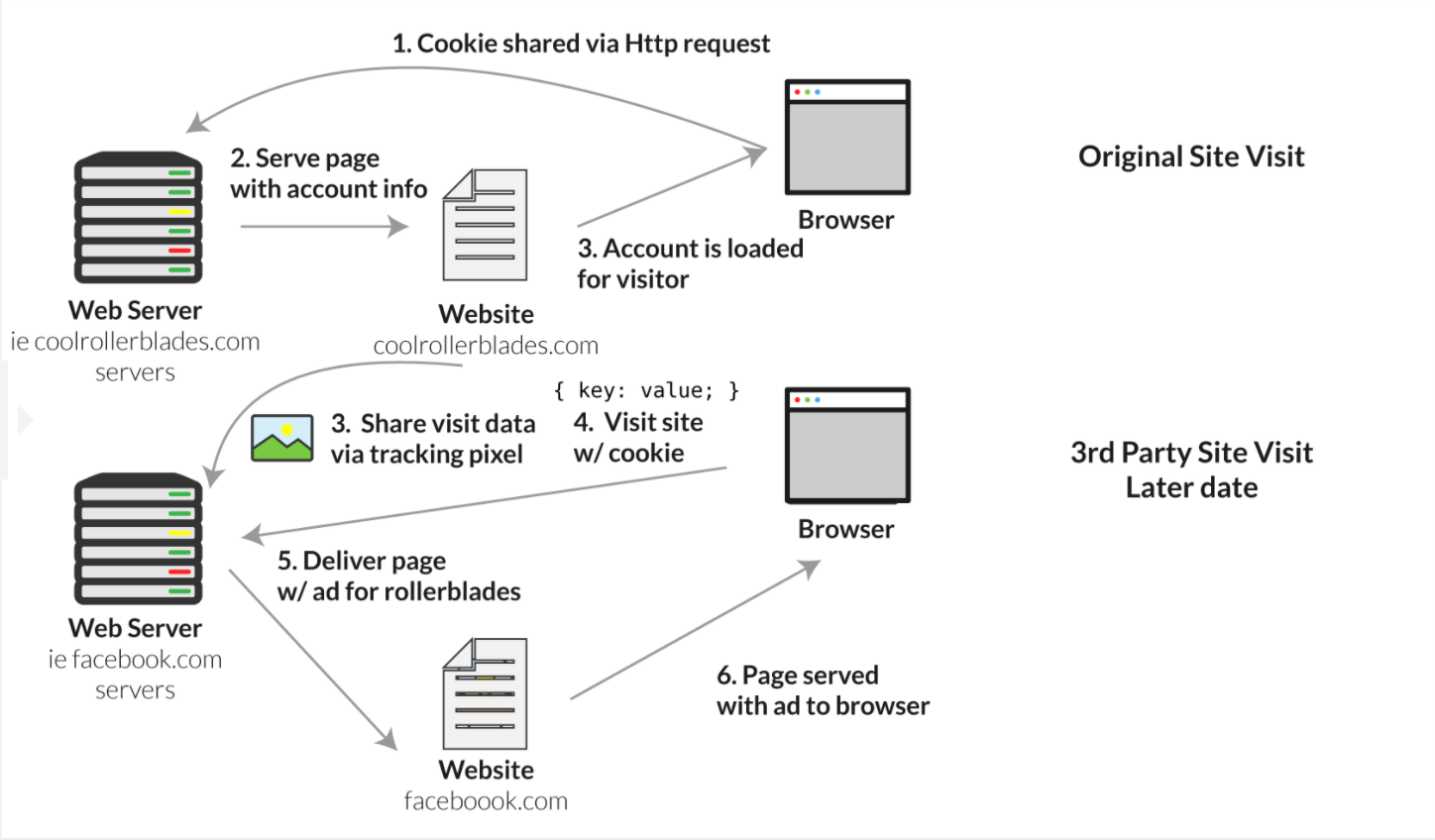
Below is a diagram explaining how first-party and third-party cookies work.
##### The rise of third-party cookies and it’s use in the advertising industry
Third-party cookies have played an integral role in the digital advertising business because it allowed advertisers to directly target users’ specific interests. And the more advertisers know about you, the easier it is for them to assume your buying habits.
Targeted advertising is a form of online advertising that utilizes customers’ habits, interests, and preferences. When a person views a product on a website, the person’s browser keeps track of your visits by storing that information on your computer (cookies).
Cookies help ad networks, social networks, and sites share information based on what the user viewed. It’s original intent was to retain information like what you put in your shopping cart or what site you were looking at, which became very helpful for advertisers.
(If you want to read more about cookies and how targeted ads work, check out one of our blog articles [here](https://meetotis.com/blog/targeted-advertising-in-a-digital-conscious-society)).
##### No more third-party cookies? What does this mean?
Without the use of third-party cookies, when a user clicks a page, they just become another random user with no associations to them and the action they just did.
[Lou Montulli](https://www.bloomberg.com/opinion/articles/2021-03-05/google-puts-lid-on-cookie-jar-and-ends-an-internet-era), a computer programmer working for startup, Netscape Communications Corp., had a great analogy to explain this:
> This is a bit like talking to someone with Alzheimer’s disease. Each interaction would result in having to introduce yourself again, and again, and again.
##### Google’s alternative solution: from cookies to cohorts
The alternative for Google is, rather than tracking and targeting based on an individual user, they will group users into a crowd of people with similar general interests called “cohorts.”
The browser will now use your recent browsing history to create a “cohort identity.” In each cohort there could be thousands of individual users and you’ll have ads targeting your cohort, rather than you as an individual.
Google argues that this will grant users more privacy because it moves away from individual tracking and targeting that made third-party cookies highly invasive to their personal information.
However, many advertisers may not be too happy with this even though Google reassured their new technique would be [95%](https://theconversation.com/googles-scrapping-third-party-cookies-but-invasive-targeted-advertising-will-live-on-156530) as effective as individual targeting.
About the author
Chiara Squillantini
Creative Director
Chiara Squillantini is the Creative Director at Otis AI, where she has been shaping branding and marketing strategies since August 2020, ensuring consistency across Otis AI’s marketing efforts. She holds a background in copywriting, marketing research, and brand management from Ace Saatchi & Saatchi, Royce Agency, and Unilever Philippines, respectively. She is passionate about digital marketing and technology and likes to share insights on digital marketing trends through blog articles and press releases for Otis AI.